I don't know how many obituaries I've written or edited over the years. It's in the thousands, probably tens of thousands. Mostly they just roll by, more grist for the endless copy mill that newspaper work is.
Occasionally, one stops me cold. Usually, it's a kid. Not hard to figure why that is. Sometimes, it's a photo that does it. I remember an obit a few months ago at The Outpost for a woman who had been a nurse for the troops during World War II. I don't know what she looked like when she died, but the photo proved that she had been one stunningly gorgeous nurse. Any soldier who woke up in a hospital with her leaning over the bed would just have to get better.
Sometimes one sends me into a blue funk for no good reason at all. Maybe somebody who died with no survivors. Or who was sick for many years before dying. Or, for no reason at all that I can detect, just out of the blue one or another gets to me.
A few minutes ago, it was an obit for a 34-year-old waitress. She graduated from Senior High School. She had two kids. She died of breast cancer.
Zap, it hit me. Damn. You come into life with no guarantee except that one day you will leave it, and that's fair, I suppose. But sometimes it just doesn't seem right.
So here I am having my own private Memorial Day for somebody I never knew, other than through a half-dozen paragraphs in the paper. In a way, it feels like I knew her forever.
Sunday, May 29, 2005
Friday, May 27, 2005
'Diezmo' redux
Since my comments on "The Diezmo" drew so much attention below, I wrote a full review for the Outpost. Also, the last thing you will ever need to read about the Bauer-Tussing dispute.
Thursday, May 26, 2005
V.P.
OK, I give up. I've read this story three times now, and I still don't see where it says what effect, if any, the designation of Michael Gulledge as a vice president of Lee will have on his job at The Gazette. We are told that he plans to stay in Billings, which would seem to be unnecessary information if we knew he was staying on as publisher. But we don't know that.
Help! What the heck does a vice president do anyway? I was at Lee for five years, and I can't recall that I ever heard of a vice president doing anything. Maybe he's the guy who goes around and fires publishers who don't make "plan." Not much of a job, but somebody has to do it.
Help! What the heck does a vice president do anyway? I was at Lee for five years, and I can't recall that I ever heard of a vice president doing anything. Maybe he's the guy who goes around and fires publishers who don't make "plan." Not much of a job, but somebody has to do it.
Tuesday, May 24, 2005
Keep your hands out of my pocket
Here's why I think the government shouldn't be in the economic development business. Not only do they want to spend my money, they don't want me to know about it.
Sunday, May 22, 2005
Prescient Molnar
Public Service Commissioner (and former Outpost columnist) Brad Molnar stopped by and pointed out that the guts of this Great Falls Tribune story showed up in The Outpost back in September 2003.
What's the dirt?
So what's up with Dirt Between Light Bulbs? I've been plotting a column on the prospects for a good blogging war in the next political campaign, and figured these guys for a prominent role. But when I go there these days, the latest thing I see is an April 11 entry. How can I shape the news to fit my preexisting biases, complete with mandatory "he said, she said" dueling quotes, if you fellows won't cooperate?
Political blogging in Montana can't live by Matt Singer alone. And Mtpolitics.net is threatening (perhaps idly) to cut back on posting. Dave Budge may have to become my go-to guy for conservative posts.
Political blogging in Montana can't live by Matt Singer alone. And Mtpolitics.net is threatening (perhaps idly) to cut back on posting. Dave Budge may have to become my go-to guy for conservative posts.
Blasting Burns
Outpost readers have plenty to say about a letter to the editor this week blasting Sen. Conrad Burns' position on wild horses.
Saturday, May 21, 2005
Instaflub
Matt Welch makes quite reasonable points about news media and the war, to which Instapundit responds in characteristically lame fashion. Welch notes that if Americans think the press is "on the other side" in the War on Terror, then Americans are wrong, and Reynolds does neither the press nor press freedom any favors by feeding that false perception.
Reynolds responds that nobody believes reporters actually want to lose the war (with one possible exception). But he says they act "almost as if" they do. When my first-year students write something like that, I pull out my marking pen. To say that I almost won a Pulitzer Prize is just another way of saying I didn't win a Pulitzer Prize. Write what you mean to say, I tell them, not what you almost mean to say. So if Reynolds agrees with Welch that reporters aren't disloyal, why does he call Welch's argument "weak"?
To do so, he has to strain logic. He says that "leading representatives" of journalism are loyal not to the United States but to journalism. I'm no "leading representative," but I've been an American for 54 years and a journalist for 25. I've yet to detect any meaningful conflict between my citizenship and my profession. The only conflict Instapundit cites is a hypothetical one that actually is rather easy to answer but takes time that I don't have right now. Journalism, practiced properly, serves the cause of truth, and truth serves the cause of freedom, so the better the journalism the stronger the country. If American soldiers are flushing Qurans down the toilet, then Americans ought to know about it because Americans are ultimately responsible for the behavior of their soldiers. If soldiers aren't flushing the Quran, then nobody should be reporting that they are. The question is strictly one of competence, not of loyalty.
Instapundit then tosses out a few sloppy characterizations. First: "You go out of your way to report bad news, and bury the good news." Yes, reporters do go out of their way to report bad news because almost no bad news would get reported if they didn't. Big companies and the government pay people to make sure the good news gets out. Because reporting bad news is harder work than reporting good news, and because readers tend to react more strongly to it (imagine how much attention Instapundit would ever devote to a story Newsweek reported accurately), bad news is often overplayed. But that's the nature of the beast and irrelevant to the larger point about loyalty. Second: "[You] treat all positive news as presumptive lies." That's just presumptive bunk. To give just one of thousands of possible examples: Voter turnout in Iraqi elections. Positive news, right? Presumptive lie? Who says?
Finally, Reynolds offers an interesting comparison to coverage of racial issues. He notes, correctly, that the press changed the way it reported on minorities in response to an understanding that the old way of covering race was destructive. What he doesn't note is that the change took a very long time. When I was a cub reporter, it was still common to get calls from people who wanted to know whether an accused criminal was black or white, and who couldn't understand why we wouldn't print that. In the late '70s, we were still struggling to overcome habits of thought and mind that had ruled the press and the nation for well over 100 years. And the change came only after a couple of enormous national convulsions that finally forced the press and the public to face up to their attitudes about race.
The point is that the press (with some honorable exceptions) didn't exactly lead the way in shaping public attitudes about race. The press reflected what the public thought, which tends, unfortunately, to be what the press typically does. For Instapundit to latch onto that as a model for covering the War on Terror shows how weak his grasp of these issues is.
To accuse reporters of wanting the terrorists to win is essentially to accuse them not only of a suicidal impulse but also of treason. And to accuse them of acting "almost as if they" wanted terrorists to win is to accuse them of "almost treason" or, perhaps, to "almost accuse them of treason." If Reynolds has the courage and the evidence to make the treason charge, then he should do so explicitly, naming names and preparing legal briefs. If he lacks the courage and the evidence, then he should do what Newsweek ought to have done: Shut up.
Reynolds responds that nobody believes reporters actually want to lose the war (with one possible exception). But he says they act "almost as if" they do. When my first-year students write something like that, I pull out my marking pen. To say that I almost won a Pulitzer Prize is just another way of saying I didn't win a Pulitzer Prize. Write what you mean to say, I tell them, not what you almost mean to say. So if Reynolds agrees with Welch that reporters aren't disloyal, why does he call Welch's argument "weak"?
To do so, he has to strain logic. He says that "leading representatives" of journalism are loyal not to the United States but to journalism. I'm no "leading representative," but I've been an American for 54 years and a journalist for 25. I've yet to detect any meaningful conflict between my citizenship and my profession. The only conflict Instapundit cites is a hypothetical one that actually is rather easy to answer but takes time that I don't have right now. Journalism, practiced properly, serves the cause of truth, and truth serves the cause of freedom, so the better the journalism the stronger the country. If American soldiers are flushing Qurans down the toilet, then Americans ought to know about it because Americans are ultimately responsible for the behavior of their soldiers. If soldiers aren't flushing the Quran, then nobody should be reporting that they are. The question is strictly one of competence, not of loyalty.
Instapundit then tosses out a few sloppy characterizations. First: "You go out of your way to report bad news, and bury the good news." Yes, reporters do go out of their way to report bad news because almost no bad news would get reported if they didn't. Big companies and the government pay people to make sure the good news gets out. Because reporting bad news is harder work than reporting good news, and because readers tend to react more strongly to it (imagine how much attention Instapundit would ever devote to a story Newsweek reported accurately), bad news is often overplayed. But that's the nature of the beast and irrelevant to the larger point about loyalty. Second: "[You] treat all positive news as presumptive lies." That's just presumptive bunk. To give just one of thousands of possible examples: Voter turnout in Iraqi elections. Positive news, right? Presumptive lie? Who says?
Finally, Reynolds offers an interesting comparison to coverage of racial issues. He notes, correctly, that the press changed the way it reported on minorities in response to an understanding that the old way of covering race was destructive. What he doesn't note is that the change took a very long time. When I was a cub reporter, it was still common to get calls from people who wanted to know whether an accused criminal was black or white, and who couldn't understand why we wouldn't print that. In the late '70s, we were still struggling to overcome habits of thought and mind that had ruled the press and the nation for well over 100 years. And the change came only after a couple of enormous national convulsions that finally forced the press and the public to face up to their attitudes about race.
The point is that the press (with some honorable exceptions) didn't exactly lead the way in shaping public attitudes about race. The press reflected what the public thought, which tends, unfortunately, to be what the press typically does. For Instapundit to latch onto that as a model for covering the War on Terror shows how weak his grasp of these issues is.
To accuse reporters of wanting the terrorists to win is essentially to accuse them not only of a suicidal impulse but also of treason. And to accuse them of acting "almost as if they" wanted terrorists to win is to accuse them of "almost treason" or, perhaps, to "almost accuse them of treason." If Reynolds has the courage and the evidence to make the treason charge, then he should do so explicitly, naming names and preparing legal briefs. If he lacks the courage and the evidence, then he should do what Newsweek ought to have done: Shut up.
Thursday, May 19, 2005
Tussing gone
Just got a news release from the city of Billings announcing that Police Chief Ron Tussing has resigned "following a buy-out of his position today by the City of Billings."
Approval of the settlement is to be considered on Monday.
My take on last week's hearing is here.
Approval of the settlement is to be considered on Monday.
My take on last week's hearing is here.
Tuesday, May 17, 2005
Flushing the Quran
Sarpy Sam invites comment from Ed Kemmick and me (as the "professional journalists" of the Montana blogosphere) on Newsweek's Quran-flushing fiasco. Ed responds here; as Sarpy Sam speculates, I don't have much to add to the discussion.
I will say that I felt a bit heartsick at news of the error. When honest mistakes crop up in news reports, I nearly always feel bad for the reporter because I know how that feels, and I know how easy it is to make mistakes. I expect to make a few today. Beyond that, it's not too hard to see how the error occurred. Such allegations had been floating around for a while; the information came from a source that had been reliable in the past; and the whole thing amounted to just a single sentence.
But it does appear the sourcing was sloppy -- in exactly the same way as the CBS forged documents story was sloppy. In both cases, reporters floated the story by government officials; when officials didn't shoot the story down, reporters took that as confirmation. That ain't smart.
BONUS OBSERVATION: Before news of the error broke, Bill Maher said that the most interesting aspect of this story was the remarkable capacity of the toilet. He said he can't even get a Jehovah's Witness tract down his toilet.
I will say that I felt a bit heartsick at news of the error. When honest mistakes crop up in news reports, I nearly always feel bad for the reporter because I know how that feels, and I know how easy it is to make mistakes. I expect to make a few today. Beyond that, it's not too hard to see how the error occurred. Such allegations had been floating around for a while; the information came from a source that had been reliable in the past; and the whole thing amounted to just a single sentence.
But it does appear the sourcing was sloppy -- in exactly the same way as the CBS forged documents story was sloppy. In both cases, reporters floated the story by government officials; when officials didn't shoot the story down, reporters took that as confirmation. That ain't smart.
BONUS OBSERVATION: Before news of the error broke, Bill Maher said that the most interesting aspect of this story was the remarkable capacity of the toilet. He said he can't even get a Jehovah's Witness tract down his toilet.
Diezmo
John Clayton cites a couple of unfavorable and one favorable review of Rick Bass's new novel, Diezmo. I just finished the book this morning, and I can say, without equivocation, that I agree with all three reviews.
The book doesn't read much like a novel at all. The fictional narrator is annoyingly inert, and even larger-than-life characters like Bigfoot Wallace seem diminished. Bass seems to have been torn between making things up and sticking to the facts, and wound up writing a book that reads more like an extended essay than a work of fiction.
But what an essay. The book chronicles the Mier Expedition, a chapter of Texas history with inextinguishable appeal for natives of the state. It was a sordid affair, a violent episode of border looting and murder during the days of the Texas Republic, but it draws me for several reasons:
1. I read a biography of Bigfoot Wallace when I was a kid, and it has stuck with me forever.
2. The infamous black bean episode, in which Mexican soldiers decided which 10 percent (hence the novel's title) of Texan prisoners to execute by having them draw beans from a bag containing 10 white beans for each black one. Those who drew black beans were immediately shot. One legend is that Bigfoot Wallace drew a white bean, then gave it away as a gesture of kindness and drew another. Bass doesn't repeat that story, but does say that Wallace lingered over the bag, feeling among the beans for the smallest one, which he believed would be white. It was instead a mottled color, and his captors had to rule it white to spare his life.
3. My father preached for seven years at La Grange, Texas, which is best known to most people as the home of the house of ill repute immortalized in The Best Little Whorehouse in Texas. But it also is near Monument Hill, a sheer bluff rising out of the Central Texas prairie where the men of the expedition were buried overlooking the Colorado River. We spent many lazy Sunday afternoons on that bluff, playing and gazing on the burial vault in which those men lie.
I was pretty darned excited when I learned that Bass had written about the expedition, and while I can't praise it highly as a novel, I found it very, very hard to put down.
The book doesn't read much like a novel at all. The fictional narrator is annoyingly inert, and even larger-than-life characters like Bigfoot Wallace seem diminished. Bass seems to have been torn between making things up and sticking to the facts, and wound up writing a book that reads more like an extended essay than a work of fiction.
But what an essay. The book chronicles the Mier Expedition, a chapter of Texas history with inextinguishable appeal for natives of the state. It was a sordid affair, a violent episode of border looting and murder during the days of the Texas Republic, but it draws me for several reasons:
1. I read a biography of Bigfoot Wallace when I was a kid, and it has stuck with me forever.
2. The infamous black bean episode, in which Mexican soldiers decided which 10 percent (hence the novel's title) of Texan prisoners to execute by having them draw beans from a bag containing 10 white beans for each black one. Those who drew black beans were immediately shot. One legend is that Bigfoot Wallace drew a white bean, then gave it away as a gesture of kindness and drew another. Bass doesn't repeat that story, but does say that Wallace lingered over the bag, feeling among the beans for the smallest one, which he believed would be white. It was instead a mottled color, and his captors had to rule it white to spare his life.
3. My father preached for seven years at La Grange, Texas, which is best known to most people as the home of the house of ill repute immortalized in The Best Little Whorehouse in Texas. But it also is near Monument Hill, a sheer bluff rising out of the Central Texas prairie where the men of the expedition were buried overlooking the Colorado River. We spent many lazy Sunday afternoons on that bluff, playing and gazing on the burial vault in which those men lie.
I was pretty darned excited when I learned that Bass had written about the expedition, and while I can't praise it highly as a novel, I found it very, very hard to put down.
Monday, May 16, 2005
Attack dog
Even moderate Republicans are getting turned off by the persistent nastiness and partisanship of the MT GOP Ebrief. Pete Hansen, who describes himself as "35 degrees left of the far right," sent me his response to a May 10 Ebrief that started this way: "Our petulant little tyrant of a governor has struck again, giving us a third example of the complete lack of respect that he has for his office."
Pete responded, in part: "Could we possibly have a little less of the 'Junkyard Dog' rhetoric and a bit of moderation? The party, of which I am one, is taking on the appearance of a small dog snapping at the ankles of both the Governor and the Democrats in toto at any opportunity! Frankly, you're not making a lot of friends among the electorate and, if continued, your actions will continue us as a minority party in years to come. Many folks I talk to, from both parties, are fed up with the 'Them and Us' actions of the legislature thus far."
To which Chuck Denowh of MT GOP responded: "I'm not sure what you mean. When the Democrats do something bad, we have to call them on it. I'm not about to let them skate through unchecked. Keep in mind that our email newsletter is for our Republican base. I wish it were more widespread and that more of the independent electorate were engaged enough to read it, but that's just not realisitic. There's nothing wrong with partisanship - but there is plenty wrong with hypocricy."
Let's see. A party member complains that divisive rhetoric is turning off reasonable people in the middle, and the party defends divisive rhetoric by arguing that reasonable people in the middle aren't engaged. Can Denowh really be this clueless?
Pete responded, in part: "Could we possibly have a little less of the 'Junkyard Dog' rhetoric and a bit of moderation? The party, of which I am one, is taking on the appearance of a small dog snapping at the ankles of both the Governor and the Democrats in toto at any opportunity! Frankly, you're not making a lot of friends among the electorate and, if continued, your actions will continue us as a minority party in years to come. Many folks I talk to, from both parties, are fed up with the 'Them and Us' actions of the legislature thus far."
To which Chuck Denowh of MT GOP responded: "I'm not sure what you mean. When the Democrats do something bad, we have to call them on it. I'm not about to let them skate through unchecked. Keep in mind that our email newsletter is for our Republican base. I wish it were more widespread and that more of the independent electorate were engaged enough to read it, but that's just not realisitic. There's nothing wrong with partisanship - but there is plenty wrong with hypocricy."
Let's see. A party member complains that divisive rhetoric is turning off reasonable people in the middle, and the party defends divisive rhetoric by arguing that reasonable people in the middle aren't engaged. Can Denowh really be this clueless?
Sunday, May 15, 2005
Grapette gone bad
The good news: Grapette, one of the joys of my tender years, is back. The bad news: You have to go to Wal-Mart to get it. Even worse news: The distinctive bottle shape (see photo) isn't coming back.
Oh! Lost youth.
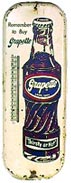
Grapette
Oh! Lost youth.
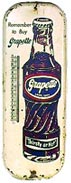
Grapette
Friday, May 13, 2005
Tussing on trial
I spent most of today at the due process hearing for Police Chief Ron Tussing. I won't take time to report on it now, but here are a couple of general observations:
1. If it's fireworks you were after, forget it. Kristoff Bauer didn't appear, sending an assistant instead. Tussing was there, but his lawyer, Michael Rapkoch, did all his talking for him. Tina Volek, sitting in for Bauer, showed less animation that a Hanna-Barbera cartoon. Rapkoch, who has been ill, wore down as the day went on, although he got off a few good shots, mostly in defense of the chief's First Amendment right to speak out. But at one point, about six hours into the proceeding, he acknowledged that for spectators the hearing must have been about as exciting as watching paint dry. At the instant he said that, a glorious image of a picket fence, covered in bright paint, glistening in the sun on a warm spring day, drying to beat the band, leapt into my mind.
2. I was amazed at how weak the city's case seemed to be. It really did seem that, as Tussing's written introductory remarks indicated, that Bauer is just out trying to cobble together evidence to justify a decision he already had made. When I wrote this column about Tussing's atheism remark, it bothered me that I might be blowing a pretty small matter out of proportion. But after sitting through five or six hours of the hearing, the atheism stuff seemed to be the strongest material the city had. It was one of the very few things Tussing admitted to having done wrong, and he apologized for it.
1. If it's fireworks you were after, forget it. Kristoff Bauer didn't appear, sending an assistant instead. Tussing was there, but his lawyer, Michael Rapkoch, did all his talking for him. Tina Volek, sitting in for Bauer, showed less animation that a Hanna-Barbera cartoon. Rapkoch, who has been ill, wore down as the day went on, although he got off a few good shots, mostly in defense of the chief's First Amendment right to speak out. But at one point, about six hours into the proceeding, he acknowledged that for spectators the hearing must have been about as exciting as watching paint dry. At the instant he said that, a glorious image of a picket fence, covered in bright paint, glistening in the sun on a warm spring day, drying to beat the band, leapt into my mind.
2. I was amazed at how weak the city's case seemed to be. It really did seem that, as Tussing's written introductory remarks indicated, that Bauer is just out trying to cobble together evidence to justify a decision he already had made. When I wrote this column about Tussing's atheism remark, it bothered me that I might be blowing a pretty small matter out of proportion. But after sitting through five or six hours of the hearing, the atheism stuff seemed to be the strongest material the city had. It was one of the very few things Tussing admitted to having done wrong, and he apologized for it.
Tuesday, May 10, 2005
Revamping the school board
Considering the dismal turnout at last week's school board election, isn't it time to roll back the clock and get rid of single-member districts?
Not yet. At least not according to Jim Hartung, one of the driving forces behind the effort to split School District 2 into districts. I saw Jim at Artwalk on Friday (a good time was had by all) and he didn't seem the least bit disheartened. Lots of people still haven't figured out the change, he said (a depressing but probably accurate observation), and, anyway, enough good candidates surfaced to avoid a bad outcome.
True enough, I guess. I supported single-member districts for two reasons:
1. School board candidates running races across the entire school district were running in areas substantially larger than legislative districts. In a nonpartisan race for a nonpaying job, that's prohibitively difficult. Candidates either spent a lot of their own money or didn't spend much of anything at all.
2. Different areas of Billings really do have different interests and vote in very different ways. I documented that at considerable length in the Outpost a couple of years ago, but can't link because the site appears to be down for technical reasons.
Both of those reasons still make sense to me. But my big concern was that single-member districts would reduce turnout and make it harder to find good candidates. That concern is still intact.
UPDATE: The link is working now.
Not yet. At least not according to Jim Hartung, one of the driving forces behind the effort to split School District 2 into districts. I saw Jim at Artwalk on Friday (a good time was had by all) and he didn't seem the least bit disheartened. Lots of people still haven't figured out the change, he said (a depressing but probably accurate observation), and, anyway, enough good candidates surfaced to avoid a bad outcome.
True enough, I guess. I supported single-member districts for two reasons:
1. School board candidates running races across the entire school district were running in areas substantially larger than legislative districts. In a nonpartisan race for a nonpaying job, that's prohibitively difficult. Candidates either spent a lot of their own money or didn't spend much of anything at all.
2. Different areas of Billings really do have different interests and vote in very different ways. I documented that at considerable length in the Outpost a couple of years ago, but can't link because the site appears to be down for technical reasons.
Both of those reasons still make sense to me. But my big concern was that single-member districts would reduce turnout and make it harder to find good candidates. That concern is still intact.
UPDATE: The link is working now.
Monday, May 09, 2005
Schweitzer for the defense
Gov. Brian Schweitzer was on the phone this morning to defend his line-item veto of certain reporting requirements contained in the budget bill. I criticized the veto in a post below.
The governor essentially made two points:
1. The reporting requirements imposed by the Legislature violate the Montana Constitution, a point that even legislative attorney Greg Petesch has acknowledged may be valid. Petesch went on to hold that even if the requirements were improper, they couldn't be vetoed after the Legislature adjourned. The governor, naturally, disputes this assertion.
2. The legislative requirements would impose a lot of new and unnecessary paperwork that nobody would bother to read anyway. Schweitzer is more interested in proceeding with plans to streamline government, which he says could save $60 million. The House defeated his performance review proposal on a 50-50 party-line vote.
I think that's a fair summary of his position. I'm not totally won over because I don't see why it's worth a legal fight over information that the public (not to mention the Legislature) is mostly entitled to have anyway. But you have to hand it to Schweitzer: He's not afraid to go to bat right out loud for his positions.
The governor essentially made two points:
1. The reporting requirements imposed by the Legislature violate the Montana Constitution, a point that even legislative attorney Greg Petesch has acknowledged may be valid. Petesch went on to hold that even if the requirements were improper, they couldn't be vetoed after the Legislature adjourned. The governor, naturally, disputes this assertion.
2. The legislative requirements would impose a lot of new and unnecessary paperwork that nobody would bother to read anyway. Schweitzer is more interested in proceeding with plans to streamline government, which he says could save $60 million. The House defeated his performance review proposal on a 50-50 party-line vote.
I think that's a fair summary of his position. I'm not totally won over because I don't see why it's worth a legal fight over information that the public (not to mention the Legislature) is mostly entitled to have anyway. But you have to hand it to Schweitzer: He's not afraid to go to bat right out loud for his positions.
Day off
Wow. In honor of Mother's Day and the end of the semester, I just took Sunday off. Well, not entirely off -- I spent a few hours grading papers -- but it was so close to a day off that it felt like paradise: sleeping until 10, a leisurely breakfast, afternoon in the hot tub, a nap, and then cooking a delicious (and spicy) hot chicken curry with a bottle of shiraz and strawberry shortcake for dessert.
It was my first day off since Jan. 1 and, I think, my first Sunday off in five years. Just carrying out the garbage seemed like an insane luxury -- pleasant, useful and undemanding labor that benefited no one but me.
Somewhere in mid-afternoon in occurred to me that there are people out there who spend every Sunday that way. Ain't life grand?
It was my first day off since Jan. 1 and, I think, my first Sunday off in five years. Just carrying out the garbage seemed like an insane luxury -- pleasant, useful and undemanding labor that benefited no one but me.
Somewhere in mid-afternoon in occurred to me that there are people out there who spend every Sunday that way. Ain't life grand?
Saturday, May 07, 2005
Going to court
Maybe I don't understand the issue, but it sure seems to me that Schweitzer is wrong, wrong, wrong on this one.
Even if turns out that he's right on the constitutional question, what makes this a fight worth having?
Even if turns out that he's right on the constitutional question, what makes this a fight worth having?
Indian giving
Lots of interesting comments this week on Roger Clawson's column about alleged government giveaways to Indians.
Some of them are even pro-Clawson. How often do you get to read something like that?
Some of them are even pro-Clawson. How often do you get to read something like that?
Tuesday, May 03, 2005
Beer bust
If I had known it was going to cause a national economic crisis, I wouldn't have cut back on my beer drinking.
Sunday, May 01, 2005
Hiatus
The hiatus on this blog will last a bit longer. I finished up classwork at Rocky last week, but still have a final and a lot of grading to do. I'll finish this week at MSU-Billings, then there's quite a bit to clear off the desk here at the Outpost, including monthly billing and some very difficult decisions about where this paper is going and how it's going to get there.
So it will be next week at the earliest before there's much to read here. So move along now.
So it will be next week at the earliest before there's much to read here. So move along now.
Sunday, April 24, 2005
Murdoch on the press
I had meant earlier to link to this speech by Rupert Murdoch to the American Society of Newspaper Editors. The speech has gotten a lot of play in the blogosphere, not, I suspect, so much for its content as for who said it.
But one statistic caught my eye: "According to one recent study, the percentage of national journalists who have a great deal of confidence in the ability of the American public to make good decisions has declined by more than 20 points since 1999." That number was new to me.
Murdoch opines, "Perhaps this reflects their personal politics and personal prejudices more than anything else, but it is disturbing." Perhaps. I suspect that it may reflect a reaction to the fairly overwhelming public distrust of journalists. If I know I'm telling the truth, and you call me a liar, then my respect for your judgment diminishes.
But I agree with Murdoch that it's a disturbing number. When journalists think their readers are stupid, that can't be good for journalism.
Here at The Outpost, I struggle with the opposite problem. I think Outpost readers are the bee's knees. It's the nonreaders I don't trust. Sometimes on Thursdays, when I'm out delivering papers all day long, I catch myself silently cursing the intelligence and character of people who walk by our racks without picking up a copy.
I'm not saying that's smart, and I'm not proud of it. But if you ever see me on Thursday with a couple of bundles of Outposts under my arm, you might want to ask for a copy. Someday, who knows? I might just blow.
But one statistic caught my eye: "According to one recent study, the percentage of national journalists who have a great deal of confidence in the ability of the American public to make good decisions has declined by more than 20 points since 1999." That number was new to me.
Murdoch opines, "Perhaps this reflects their personal politics and personal prejudices more than anything else, but it is disturbing." Perhaps. I suspect that it may reflect a reaction to the fairly overwhelming public distrust of journalists. If I know I'm telling the truth, and you call me a liar, then my respect for your judgment diminishes.
But I agree with Murdoch that it's a disturbing number. When journalists think their readers are stupid, that can't be good for journalism.
Here at The Outpost, I struggle with the opposite problem. I think Outpost readers are the bee's knees. It's the nonreaders I don't trust. Sometimes on Thursdays, when I'm out delivering papers all day long, I catch myself silently cursing the intelligence and character of people who walk by our racks without picking up a copy.
I'm not saying that's smart, and I'm not proud of it. But if you ever see me on Thursday with a couple of bundles of Outposts under my arm, you might want to ask for a copy. Someday, who knows? I might just blow.
Saturday, April 23, 2005
More winners
Here are a couple of more legislative winners I meant to mention:
Dave Wanzenreid: After he was maneuvered out of the House speaker job, Rep. Wanzenreid, D-Missoula, could have spent the rest of the session pouting. Instead, he took the defeat with class and held Democrats together during crucial votes.
Alternative energy: Wilbur Wood, who has been writing about wind energy and other alternative energy sources, says that amendments took much of the meat out of the final version of Senate Bill 415. But renewables are on the map now, and they won't go away.
Dave Wanzenreid: After he was maneuvered out of the House speaker job, Rep. Wanzenreid, D-Missoula, could have spent the rest of the session pouting. Instead, he took the defeat with class and held Democrats together during crucial votes.
Alternative energy: Wilbur Wood, who has been writing about wind energy and other alternative energy sources, says that amendments took much of the meat out of the final version of Senate Bill 415. But renewables are on the map now, and they won't go away.
Legislature: Who won?
Here's my quick read on winners and losers in the legislative session. In true blogging fashion, I have based these judgments on virtually no research, so your corrections and improvements are welcome.
Winners
Brian Schweitzer: I'm not persuaded that the governor did as well as he thinks he did, but considering that he was breaking in his first elective office with a slim legislative majority, anything this side of total disaster has to be a positive. Give him a B.
Jon Tester: The Senate president promised to be fair and bipartisan, and, by and large, he seemed to keep that promise. Now there's talk he'll run for Congress.
The ACLU: Strange, but true. Not only did public defender legislation pass in an effort to ward off an ACLU suit, the Legislature also lined up behind a resolution against the Patriot Act.
Losers
Education: It probably was too much to expect a solution to school funding problems to come out of this session, but Sen. Corey Stapleton, R-Billings, was right: Legislators should have debated education until the bitter end. Heck, I haven't had a day off since January; why shouldn't the Legislature burn 90 days of midnight oil? Back to Helena, folks.
Republicans: As I have noted before, I hold Republican leader Roy Brown in considerable esteem. I think he's smart and honest and fights for what he genuinely thinks is right. But I thought Republicans were much too quick to adopt the minority party role. They ought to have played from a position of strength: We're still the majority party in this state, and don't think a little gerrymandering changes that. Either show some bipartisan cooperation, or eat our dust in the next election. But conservative Republicans can't seem to shed the minority mentality: Sean Hannity has 12 million radio listeners, and his party controls the presidency and both houses of Congress, yet he still sounds every day like a besieged minority. Time to grow up.
Too close to call
Democrats: Interesting session for Democrats. On one hand, they had a fat surplus to spend -- every politician's wet dream. On the other, they had genuine needs to meet from court cases and a dozen years of tight budgets. It's one thing to freeze state workers' pay when the state's struggling to stay in the black, quite another when the Legislature has a couple of hundred million to play around with.
So Democrats had to spend, but they also had to avoid as much as possible the big spender label. Tough trick to pull off, and Republicans weren't eager to make it easier. The spoiler is still school funding. If the Legislature can come out of a special session with a reasonable solution and no big new tax bite, the Dems should be OK. If they don't, well, welcome to 2007.
That's enough for now. I'll add more as needed.
Winners
Brian Schweitzer: I'm not persuaded that the governor did as well as he thinks he did, but considering that he was breaking in his first elective office with a slim legislative majority, anything this side of total disaster has to be a positive. Give him a B.
Jon Tester: The Senate president promised to be fair and bipartisan, and, by and large, he seemed to keep that promise. Now there's talk he'll run for Congress.
The ACLU: Strange, but true. Not only did public defender legislation pass in an effort to ward off an ACLU suit, the Legislature also lined up behind a resolution against the Patriot Act.
Losers
Education: It probably was too much to expect a solution to school funding problems to come out of this session, but Sen. Corey Stapleton, R-Billings, was right: Legislators should have debated education until the bitter end. Heck, I haven't had a day off since January; why shouldn't the Legislature burn 90 days of midnight oil? Back to Helena, folks.
Republicans: As I have noted before, I hold Republican leader Roy Brown in considerable esteem. I think he's smart and honest and fights for what he genuinely thinks is right. But I thought Republicans were much too quick to adopt the minority party role. They ought to have played from a position of strength: We're still the majority party in this state, and don't think a little gerrymandering changes that. Either show some bipartisan cooperation, or eat our dust in the next election. But conservative Republicans can't seem to shed the minority mentality: Sean Hannity has 12 million radio listeners, and his party controls the presidency and both houses of Congress, yet he still sounds every day like a besieged minority. Time to grow up.
Too close to call
Democrats: Interesting session for Democrats. On one hand, they had a fat surplus to spend -- every politician's wet dream. On the other, they had genuine needs to meet from court cases and a dozen years of tight budgets. It's one thing to freeze state workers' pay when the state's struggling to stay in the black, quite another when the Legislature has a couple of hundred million to play around with.
So Democrats had to spend, but they also had to avoid as much as possible the big spender label. Tough trick to pull off, and Republicans weren't eager to make it easier. The spoiler is still school funding. If the Legislature can come out of a special session with a reasonable solution and no big new tax bite, the Dems should be OK. If they don't, well, welcome to 2007.
That's enough for now. I'll add more as needed.
Giving Wendy's the finger
Assuming this case results in a conviction, then it's too bad about that pesky provision in the Constitution banning cruel and unusual punishment. It wouldn't be hard to think of a fitting penalty: chili con pinkie.
Racicot grilled
Those of you who don't read The Outpost regularly (damn your eyes) will want to look at this story on Marc Racicot. And those of you who do look at The Outpost probably will want to look at this (link courtesy of Tony).
Wednesday, April 20, 2005
Testy with Tester
Dirt Between Light Bulbs finds Senate President Jon Tester's logic a bit tortured. Sen. Tester essentially argued that Republican neglect of education in recent years forced Democrats to increase education spending this year.
While I don't have much use for legislators who blame the other party for their own failings, I would never get into an argument with a man who has a haircut like a drill sergeant's. But Tester, who always has struck me as a reasonable fellow, actually has a point.
Everybody knew that a lawsuit over school funding was coming. I wrote nearly four years ago that it was in the works. And most people I talked to predicted that the suit would succeed.
Now, you can talk all you want about whether the suit was reasonable and necessary. And you can argue until you're red in the face that more money doesn't necessarily equal more quality.
But the fact is, Republicans knew this suit was on the way. And they knew it would probably be successful. And they knew that success would cost the taxpayers money. And they ran the show. And now they are looking for a way to blame Democrats. That won't fly.
While I don't have much use for legislators who blame the other party for their own failings, I would never get into an argument with a man who has a haircut like a drill sergeant's. But Tester, who always has struck me as a reasonable fellow, actually has a point.
Everybody knew that a lawsuit over school funding was coming. I wrote nearly four years ago that it was in the works. And most people I talked to predicted that the suit would succeed.
Now, you can talk all you want about whether the suit was reasonable and necessary. And you can argue until you're red in the face that more money doesn't necessarily equal more quality.
But the fact is, Republicans knew this suit was on the way. And they knew it would probably be successful. And they knew that success would cost the taxpayers money. And they ran the show. And now they are looking for a way to blame Democrats. That won't fly.
Tuesday, April 19, 2005
Lee ethics: an oxymoron?
From the e-mail:
I ask you keep my name and location out of this for obvious reasons, but you could identify me (if you must) as a Lee newspaper employee...
In your April 16 post, you said the other anonymous poster was correct and that Lee has an ethics policy in its "Principles for Quality Journalism." That is very nice, but it is not an ethics policy. It's a mission statement.
If you review some other newspaper ethics policies available online, you'll see that they are strict personnel policies that -- for editorial personnel --govern how they conduct themselves. Ethics policies are hard rules on issues like conflicts of interest, acceptance of gifts, travel expenses and the like from potential news sources, etc. They generally carry severe penalties, including dismissal, for violations. Here is the San Jose Mercury News policy:
http://www.mercurynews.com/mld/mercurynews/contact_us/about/9723906.htm
for an example; it the first one that Googled up. Lee has nothing like that.
Right now, if I were a Lee reporter, I could be a member of an organization, report on that organization, and violate no company policy. I could be a stockholder in a corporation and write editorial praising that corporation. Furthermore, there is no Lee policy requiring that those relationships be disclosed to readers.
Here's one line from Lee's "Principles for Quality Journalism":
Employees shall "Play a leadership role and be a force for change in the community through coverage, editorials and civic involvement."
Lee strongly encourages middle management editorial employees to join local civic organizations and then allows those same employees to contribute to and even to author news coverage and editorials of those same organizations without disclosure to readers. That violates most other newspapers' ethics policies, and it leads to biased coverage.
I sorta expect publishers to have such community ties, but publishers don't put out the paper every day and good publishers don't insert their biases into local coverage. Lee is unusual in promoting such conflicts among its grunts in the editorial trenches.
Anyway, I've said my piece. I'm glad you're offering a forum for this discussion. I've been fighting over these issues here for years.
I ask you keep my name and location out of this for obvious reasons, but you could identify me (if you must) as a Lee newspaper employee...
In your April 16 post, you said the other anonymous poster was correct and that Lee has an ethics policy in its "Principles for Quality Journalism." That is very nice, but it is not an ethics policy. It's a mission statement.
If you review some other newspaper ethics policies available online, you'll see that they are strict personnel policies that -- for editorial personnel --govern how they conduct themselves. Ethics policies are hard rules on issues like conflicts of interest, acceptance of gifts, travel expenses and the like from potential news sources, etc. They generally carry severe penalties, including dismissal, for violations. Here is the San Jose Mercury News policy:
http://www.mercurynews.com/mld/mercurynews/contact_us/about/9723906.htm
for an example; it the first one that Googled up. Lee has nothing like that.
Right now, if I were a Lee reporter, I could be a member of an organization, report on that organization, and violate no company policy. I could be a stockholder in a corporation and write editorial praising that corporation. Furthermore, there is no Lee policy requiring that those relationships be disclosed to readers.
Here's one line from Lee's "Principles for Quality Journalism":
Employees shall "Play a leadership role and be a force for change in the community through coverage, editorials and civic involvement."
Lee strongly encourages middle management editorial employees to join local civic organizations and then allows those same employees to contribute to and even to author news coverage and editorials of those same organizations without disclosure to readers. That violates most other newspapers' ethics policies, and it leads to biased coverage.
I sorta expect publishers to have such community ties, but publishers don't put out the paper every day and good publishers don't insert their biases into local coverage. Lee is unusual in promoting such conflicts among its grunts in the editorial trenches.
Anyway, I've said my piece. I'm glad you're offering a forum for this discussion. I've been fighting over these issues here for years.
Saturday, April 16, 2005
Lee update
An e-mailer who asks to remain anonymous takes exception to an anonymous comment about Lee Enterprises below that says that "Lee is also alone among the major newspaper corporations in that it has no professional ethics policy to guide its newsgathering."
The e-mailer is correct: Lee does in fact have a statement of Principles for Quality Journalism.
David Summerlin also asks, "In your most honest moments, is it possible that your contempt for Lee is driven as much by jealousy as by high minded journalistic principles?"
It's a fair question, worth reflecting upon. My contempt for Lee actually drips at a much slower rate than Nathaniel Blumberg's. And although it is driven by many factors, jealousy, I believe I can safely say, is not one of them.
I always have ranked Lee somewhere in the middle of the pack of corporate newspaper behemoths. It offers good benefits. It has conducted layoffs with a certain restraint. Corporate headquarters seems content to stay out of local editorial matters. As competitive pressure on newspapers has intensified, Lee has doubled up on its commitment to publishing newspapers, a move that I find admirable if not especially smart.
Mr. Summerlin is correct, I believe, in saying that Lee's faults are typical of, and probably less serious than, those of larger media conglomerates. So why pick on Lee?
1. Lee is a medium-sized fish in the world of media conglomerates, but it is a great white shark in Montana. You fight the enemy where you find it.
2. All corporate newspapers, in my view, are far more alike than they are distinguishable, and their differences become tinier every year. That means that the worst newspaper companies either reform or get out of the business (Thomson, Worrell), and that the best newspaper companies cut editorial quality to jack up profits (Knight Ridder). Attempting to choose the best of the lot of is a fool's game, a meaningless scoresheet on an ever-contracting scale.
3. Most of my knowledge about Lee comes from The Gazette. At the time I worked there, I thought it was the worst-run newsroom I had ever seen, and I thought the publisher was a chronic abuser of both the staff and the newspaper's reputation. By all accounts, things are better there now, but I can't let Lee off the hook for what went on there.
4. Lee can't be relied upon to aggressively cover stories in which it is involved. Just look at how Lee covered its Pulitzer acquisition.
5. As another commenter below notes, Lee is a ruthless monopolist that tries any tactic it can think of to sew up every media-related market niche in every town where it operates. It starts pointless niche publications with no editorial aim other than to dry up advertising dollars in the market. When we ventured into the car ad business, Lee cut rates in half for selected advertisers to induce them to sign long-term contracts. It did the same thing in the early days of The Outpost. When we asked the Legislature to give us a chance to bid on county legal ads, Lee's lobbyist (so I am reliably told) threatened senators with retaliation.
Sometimes Lee's attempts to head off competition can be amazingly petty, such as the Missoulian's refusal to run help-wanted advertising for a perceived competitor. Then there's this story, which I can't prove but which was told to me by a person involved whom I believe to be reliable: The founder of a media outlet in this region was nominated for recognition in the Gazette's 40 Under 40 special edition, but the Gazette rejected the nomination because she was a competitor. A competitor? Her creation is too small even for The Outpost to worry about, and The Gazette is a hundred times larger than we are.
Jealous? That's not the word for how that sort of story makes me feel.
The e-mailer is correct: Lee does in fact have a statement of Principles for Quality Journalism.
David Summerlin also asks, "In your most honest moments, is it possible that your contempt for Lee is driven as much by jealousy as by high minded journalistic principles?"
It's a fair question, worth reflecting upon. My contempt for Lee actually drips at a much slower rate than Nathaniel Blumberg's. And although it is driven by many factors, jealousy, I believe I can safely say, is not one of them.
I always have ranked Lee somewhere in the middle of the pack of corporate newspaper behemoths. It offers good benefits. It has conducted layoffs with a certain restraint. Corporate headquarters seems content to stay out of local editorial matters. As competitive pressure on newspapers has intensified, Lee has doubled up on its commitment to publishing newspapers, a move that I find admirable if not especially smart.
Mr. Summerlin is correct, I believe, in saying that Lee's faults are typical of, and probably less serious than, those of larger media conglomerates. So why pick on Lee?
1. Lee is a medium-sized fish in the world of media conglomerates, but it is a great white shark in Montana. You fight the enemy where you find it.
2. All corporate newspapers, in my view, are far more alike than they are distinguishable, and their differences become tinier every year. That means that the worst newspaper companies either reform or get out of the business (Thomson, Worrell), and that the best newspaper companies cut editorial quality to jack up profits (Knight Ridder). Attempting to choose the best of the lot of is a fool's game, a meaningless scoresheet on an ever-contracting scale.
3. Most of my knowledge about Lee comes from The Gazette. At the time I worked there, I thought it was the worst-run newsroom I had ever seen, and I thought the publisher was a chronic abuser of both the staff and the newspaper's reputation. By all accounts, things are better there now, but I can't let Lee off the hook for what went on there.
4. Lee can't be relied upon to aggressively cover stories in which it is involved. Just look at how Lee covered its Pulitzer acquisition.
5. As another commenter below notes, Lee is a ruthless monopolist that tries any tactic it can think of to sew up every media-related market niche in every town where it operates. It starts pointless niche publications with no editorial aim other than to dry up advertising dollars in the market. When we ventured into the car ad business, Lee cut rates in half for selected advertisers to induce them to sign long-term contracts. It did the same thing in the early days of The Outpost. When we asked the Legislature to give us a chance to bid on county legal ads, Lee's lobbyist (so I am reliably told) threatened senators with retaliation.
Sometimes Lee's attempts to head off competition can be amazingly petty, such as the Missoulian's refusal to run help-wanted advertising for a perceived competitor. Then there's this story, which I can't prove but which was told to me by a person involved whom I believe to be reliable: The founder of a media outlet in this region was nominated for recognition in the Gazette's 40 Under 40 special edition, but the Gazette rejected the nomination because she was a competitor. A competitor? Her creation is too small even for The Outpost to worry about, and The Gazette is a hundred times larger than we are.
Jealous? That's not the word for how that sort of story makes me feel.
Montana astroturf
Daily Kos, one of the prominent liberal blogs, calls Dirt Between Light Bulbs the first astroturf GOP blog. Follow the link to the Swing State Project for more info about these guys. And more here from Matt Singer.
In Dirt's favor: It provided the links that led to all of the above. And Dirt claims that nobody is getting paid to run the blog. OK by me, but you had better be telling the truth. I don't care how your politics lean, but I do care where your money comes from.
In Dirt's favor: It provided the links that led to all of the above. And Dirt claims that nobody is getting paid to run the blog. OK by me, but you had better be telling the truth. I don't care how your politics lean, but I do care where your money comes from.
Sunday, April 10, 2005
Publisher of the Year
As some readers may suspect, I am no particular fan of Lee Enterprises. So you might anticipate I would have a snide response to the decision by Editor & Publisher magazine (subscription required) to name Lee CEO Mary Junck as Publisher of the Year 2005.
Actually, I don't -- except perhaps to point out that CEO and publisher are not exactly the same job, even when they are held by the same person. But that's E&P's worry, not hers.
Ms. Junck probably deserves the accolade if for no other reason than Lee's huge purchases of the Howard Publications and Pulitzer chains. That's an impressive investment in the future of a mature and probably permanently declining industry. Impressive, even if not smart -- and possibly smart, too.
A sidebar in the E&P story asks the crucial question: "Just how good are Lee's papers?" The puff-filled article quotes only one naysayer: Nathaniel Blumberg, former dean of the University of Montana journalism school. Nathaniel doesn't say much to E&P, but he says it emphatically: "My contempt for Lee Enterprises and what it has done to the journalism profession runs so deep that I prefer not to be quoted at this time."
Me neither.
Actually, I don't -- except perhaps to point out that CEO and publisher are not exactly the same job, even when they are held by the same person. But that's E&P's worry, not hers.
Ms. Junck probably deserves the accolade if for no other reason than Lee's huge purchases of the Howard Publications and Pulitzer chains. That's an impressive investment in the future of a mature and probably permanently declining industry. Impressive, even if not smart -- and possibly smart, too.
A sidebar in the E&P story asks the crucial question: "Just how good are Lee's papers?" The puff-filled article quotes only one naysayer: Nathaniel Blumberg, former dean of the University of Montana journalism school. Nathaniel doesn't say much to E&P, but he says it emphatically: "My contempt for Lee Enterprises and what it has done to the journalism profession runs so deep that I prefer not to be quoted at this time."
Me neither.
Heavy handed
An e-mailer suggests that one reason the free weeklies were able to get House Bill 474 passed (see numerous posts below) was that "Lee Newspapers has one of the most obnoxious lobbyists in the session." He adds, "I guess there is some symmetry there."
The e-mailer may have a point. One senator said that the Lee lobbyist (who also lobbies for the Montana Newspaper Association -- a disturbing conflict of interest) "threatened me with the wrath of the Gazette."
Can that be? Would a major news organization leverage its near-monopoly status to stifle free-market competition for government services? Hmmm. I'll have to think it over and get back to you.
The e-mailer may have a point. One senator said that the Lee lobbyist (who also lobbies for the Montana Newspaper Association -- a disturbing conflict of interest) "threatened me with the wrath of the Gazette."
Can that be? Would a major news organization leverage its near-monopoly status to stifle free-market competition for government services? Hmmm. I'll have to think it over and get back to you.
Saturday, April 09, 2005
Up with stupidity
"I just don't think we can legislate against stupidity," Sen. Joe Balyeat this week during a legislative debate on banning smoking in public buildings.
He's right. We probably can't legislate against stupidity. But that doesn't mean we have to elect it to office.
He's right. We probably can't legislate against stupidity. But that doesn't mean we have to elect it to office.
Wednesday, April 06, 2005
Whew
House Bill 474, the Free Weekly Legal Advertising Relief Act, has passed the Senate on third reading. Now it goes back to the House with a minor amendment.
So the little guys do occasionally win one.
So the little guys do occasionally win one.
Tuesday, April 05, 2005
Back to life
Guess I was too pessimistic below about House Bill 474. The Senate just voted to reconsider the bill, and it has been scheduled for a second reading.
I don't have any details yet. Matt Gibson, who has been fanning the flames on behalf of Montana's free weeklies, heard from a senator last night who said he thought there were enough votes to change the outcome. As of this morning, the bill still had failed, 25-23. Somewhere during the day, it picked up another vote to make it 25-24. I sent out four or five messages to senators last night, and a few more this morning.
Now, by a 30-20 vote cast this evening, we will get another chance. Since the bill already has passed the House, with a little luck we're in. Cool.
The breakdown on this evening's voting isn't up yet. In the House, all the negative votes were cast by Republicans, but party lines were less visible in the Senate on Monday. Republican Jeff Essmann, for instance, voted for us, while a good Democrat, Jim Elliott (whose column occasionally appears in The Outpost), voted against us. Republican Corey Stapleton voted against us, but so did Democrat Jon Tester.
As I was firing off e-mails this morning, it occurred to me that, for the first time in my life, I was lobbying. It was a weird feeling - violating my oath of political celibacy. Guess I am a businessman after all.
UPDATE: HB 474 has now passed on second reading, 26-22. It goes to a third reading on Wednesday.
I don't have any details yet. Matt Gibson, who has been fanning the flames on behalf of Montana's free weeklies, heard from a senator last night who said he thought there were enough votes to change the outcome. As of this morning, the bill still had failed, 25-23. Somewhere during the day, it picked up another vote to make it 25-24. I sent out four or five messages to senators last night, and a few more this morning.
Now, by a 30-20 vote cast this evening, we will get another chance. Since the bill already has passed the House, with a little luck we're in. Cool.
The breakdown on this evening's voting isn't up yet. In the House, all the negative votes were cast by Republicans, but party lines were less visible in the Senate on Monday. Republican Jeff Essmann, for instance, voted for us, while a good Democrat, Jim Elliott (whose column occasionally appears in The Outpost), voted against us. Republican Corey Stapleton voted against us, but so did Democrat Jon Tester.
As I was firing off e-mails this morning, it occurred to me that, for the first time in my life, I was lobbying. It was a weird feeling - violating my oath of political celibacy. Guess I am a businessman after all.
UPDATE: HB 474 has now passed on second reading, 26-22. It goes to a third reading on Wednesday.
Butcher block
City Lights finds itself agreeing with Sen. Ed "The Vegetable" Butcher that a bill requiring school districts to adopt anti-bullying policies is a bad idea. Note to Ed: Anytime you find yourself tempted to agree with Sen. Butcher, you should rethink your position.
I don't like the state dictating every step school districts take (and I like it even less when the feds do it) but this bill doesn't dictate a policy; it simply requires school districts to adopt one that includes a process for handling complaints. That seems to be a sufficiently modest and sensible approach to dealing with a real problem that is at least anecdotally linked to school shootings.
And it might even be good news for bullies. The lives that are saved could be theirs.
I don't like the state dictating every step school districts take (and I like it even less when the feds do it) but this bill doesn't dictate a policy; it simply requires school districts to adopt one that includes a process for handling complaints. That seems to be a sufficiently modest and sensible approach to dealing with a real problem that is at least anecdotally linked to school shootings.
And it might even be good news for bullies. The lives that are saved could be theirs.
Monday, April 04, 2005
Whittled down again
Apparently my optimism expressed below about the passage of House Bill 474 was excessive. I just got an e-mail from Matt Gibson saying that the Senate voted the bill down, 26-23, and it probably is dead for the session. Apparently the paid-circulation papers and their lobbyist got to enough senators to beat it down.
For what it's worth, here's some of the written testimony I submitted to the House:
So it's another loss for the little guy. I wish I could be the big guy for just one day.
For what it's worth, here's some of the written testimony I submitted to the House:
Newspapers were born free, but everywhere they are in chains. The number of independently owned daily newspapers in the United States has fallen from a peak of more than 2,100 to about 250 today. Many of those absent newspapers went out of business; most of the rest were absorbed by increasingly larger and increasingly more concentrated newspaper chains.
But in recent decades, alternatives have arisen. Free distribution weekly newspapers are published in nearly every major American city. During the 1990s, these newspapers doubled in circulation and revenue.
In Montana, free and independent weeklies have blossomed in the last dozen years: The Missoula Independent, the Butte Weekly, The Billings Outpost, the Queen City News here in Helena. These papers offer a genuine alternative to established weeklies and dailies, and have readerships that rank favorably with most of the state's long-established newspapers.
I regret that I cannot be here personally today. As a small publisher, I wear many hats, and I have a couple of those on today. But I do want to take a few moments to ask that we be given the same right that paid newspapers have to compete for legal notices placed by county government. I, and the publishers of these other weeklies, seek no special favors or breaks. I'm not asking that legal ads be awarded to us. I'm just asking that we be given a chance to compete. I'm not even asking for a level playing field; I just want a chance to get in the ballgame.
The Montana Newspaper Association, of which The Outpost has been a member since we started business, opposes this legislation. It will argue, among other things, that the bill, as offered, defines newspaper too loosely. The association's larger concern is that counties may use this bill as a wedge to give up legal notices in newspapers altogether.
I agree with the association that that would be a mistake. No entity in any community does more to keep the public aware of what local government is up to than the local newspaper. It just makes sense that newspapers should remain the place where citizens go to keep track of legal matters that affect them and their community.
But I believe that newspapers, like government, must be open to the changes that are sweeping communications at a pace that I have never before seen in the two decades I have practiced this craft. Without question, free weekly newspapers are a substantial portion of that change. They will play an increasingly vital role in helping to fill democracy's need for robust debate on the issues of the day. It is time that they were accepted as a legitimate and lasting force in Montana communities. Allowing them to accept county legal notices will be an important step in their growth.
So it's another loss for the little guy. I wish I could be the big guy for just one day.
Sunday, April 03, 2005
Gerrymandering
Dirt Between Light Bulbs is doing a good job of trying to track down answers to questions I raised below about Democratic gerrymandering. It's worth scrolling down through several entries to get the full story.
Saturday, April 02, 2005
One step closer
House Bill 474, which I wrote about here, has passed out of the Senate Judiciary Committee by a 7-5 vote. The bill would give free weeklies like ours a chance to bid on county legal ads -- potentially a tidy, although not terribly profitable, little sum.
The bill already passed the House by an 84-14 margin, so chances look good. If it becomes law, the most satisfying aspect will be that it is opposed both by the Montana Newspaper Association and by Lee Enterprises -- which, coincidentally enough, both have the same lobbyist. It will be a nice little win for the little guy, helped along, primarily, by Matt Gibson of the Missoula Independent.
The bill already passed the House by an 84-14 margin, so chances look good. If it becomes law, the most satisfying aspect will be that it is opposed both by the Montana Newspaper Association and by Lee Enterprises -- which, coincidentally enough, both have the same lobbyist. It will be a nice little win for the little guy, helped along, primarily, by Matt Gibson of the Missoula Independent.
Friday, April 01, 2005
Making money
In comments on my Blogcasting post below, David Summerlin makes thoughtful suggestions about commercial prospects for blogging. He suggests that an alternative model to advertising may be needed, as well as an alternative to highly populated uppercrust blog sites.
I wish I had a clue what to offer. New West obviously has its own ideas about how to make money at this, and I wish them well, I think, but I'm not convinced that approach will work. Actually, I'm not convinced any approach will work.
But just to toss something out: What if you had four bloggers sharing one site, each putting in a couple of hours a day. That way everybody has enough time to keep a day job, but yet the blog gets full-time reasonable attention. With that much blogging, I think, you could become the premier Montana news and commentary site in the state (although without, I fear, much original reporting).
It could make money from:
1. Whatever ads were available.
2. The tip jar.
3. Annual memberships (?).
Nobody would get rich, but everybody might get a little cash. And it would be a must read for all folks serious about Montana affairs. Or maybe not. Anybody got a better idea?
I wish I had a clue what to offer. New West obviously has its own ideas about how to make money at this, and I wish them well, I think, but I'm not convinced that approach will work. Actually, I'm not convinced any approach will work.
But just to toss something out: What if you had four bloggers sharing one site, each putting in a couple of hours a day. That way everybody has enough time to keep a day job, but yet the blog gets full-time reasonable attention. With that much blogging, I think, you could become the premier Montana news and commentary site in the state (although without, I fear, much original reporting).
It could make money from:
1. Whatever ads were available.
2. The tip jar.
3. Annual memberships (?).
Nobody would get rich, but everybody might get a little cash. And it would be a must read for all folks serious about Montana affairs. Or maybe not. Anybody got a better idea?
Extreme moderates
I went to a meeting of a new campus group at Rocky Mountain College on Wednesday. The idea is to organize at the grassroots level to create the Moderate Party, a rational alternative to the partisanship and bickering of the two major parties.
The name of the party elicited a few inevitable chuckles. For example, when the next meeting was set, the time was placed at 6:15 p.m. -- exactly midway between 6 p.m. and 6:30 p.m.
I am naturally skeptical about the odds of rallying support for a rational approach to politics, but I'm happy to see college students meeting to discuss such matters. Even if nothing comes of it but a few debates on the nature of political compromise, it will be time well spent. On the basis of what I have heard, the students sounded more libertarian than moderate -- an idea also worth exploring.
But that can be changed. That could be my opportunity. Since Tony Lewis keeps labeling me as an "extreme moderate," maybe I could carve out a niche as a leader of the extreme wing of the Moderate Party.
If you would like any more information about all this, let me know. I will put you in touch.
The name of the party elicited a few inevitable chuckles. For example, when the next meeting was set, the time was placed at 6:15 p.m. -- exactly midway between 6 p.m. and 6:30 p.m.
I am naturally skeptical about the odds of rallying support for a rational approach to politics, but I'm happy to see college students meeting to discuss such matters. Even if nothing comes of it but a few debates on the nature of political compromise, it will be time well spent. On the basis of what I have heard, the students sounded more libertarian than moderate -- an idea also worth exploring.
But that can be changed. That could be my opportunity. Since Tony Lewis keeps labeling me as an "extreme moderate," maybe I could carve out a niche as a leader of the extreme wing of the Moderate Party.
If you would like any more information about all this, let me know. I will put you in touch.
Thursday, March 31, 2005
Lousy day
The wife smashed up the Oldsmobile Thursday morning. Nobody hurt, at least not seriously, but the Olds got a lot older.
Lousy day
The wife smashed up the Oldsmobile Thursday morning. Nobody hurt, at least not seriously, but the Olds got a lot older. And I spent a frantic day trying to teach a class, deliver papers and tutor writing between ferrying her to the hospital.
When I got home at 8 p.m., just before falling asleep at 8:20 p.m., she said the doctor had given her a few days off work.
"Can I get a doctor's excuse?" I asked.
When I got home at 8 p.m., just before falling asleep at 8:20 p.m., she said the doctor had given her a few days off work.
"Can I get a doctor's excuse?" I asked.
Wednesday, March 30, 2005
New kid on the block
I'm adding a link to another new Montana blog, Dirt Between Light Bulbs, which appears to be interesting and well written. So I might as well go ahead and disagree with it right off the bat. Demosthenes argues that because Republicans won the popular vote for the Legislature 50-47, they should have been expected to win a 50-47 margin in the House (with three up for grabs).
T'aint so. If districts were perfectly apportioned, then the side that won just over 50 percent of the total vote (which Republicans did) would win 100 percent of the House seats. That detail matters if you are curious, as I am, about whether Democrats gerrymandered the districts before the next election. I don't dispute that Democrats tried to do it; I just wonder whether they succeeded.
It's a trickier calculation than you might at first suspect. Presumably, the purpose of gerrymandering is to create districts in which the votes of Democrats (in this case) are maximally effective while the votes of Republicans are discounted. So you try to construct districts in which Democrats win all the close races while Republicans win large victories in districts where a Republican win can't be avoided.
So did Democrats in fact win the close races while losing the lopsided ones? I actually spent a couple of hours trying to compute this for Yellowstone County in the last election, but it got too complicated, and I gave it up. To really nail it down, you would almost have to compute it on a precinct-by-precinct basis, comparing 2004 results to results from previous elections.
Even then, lots of things can go wrong. Plotting a strategy to win close races appears to be sound, but it can easily backfire. You can't afford to cut your margins too close. Did, for example, Carol Gibson lose her bid for re-election because Democrats got too clever for their own good? Hard to tell.
So did Democrats in fact successfully gerrymander the new election districts? I don't know, but I would sure like to see somebody come up with the answer.
UPDATE: For some reason, I can't link directly to the post. You'll have to scroll down to March 27.
T'aint so. If districts were perfectly apportioned, then the side that won just over 50 percent of the total vote (which Republicans did) would win 100 percent of the House seats. That detail matters if you are curious, as I am, about whether Democrats gerrymandered the districts before the next election. I don't dispute that Democrats tried to do it; I just wonder whether they succeeded.
It's a trickier calculation than you might at first suspect. Presumably, the purpose of gerrymandering is to create districts in which the votes of Democrats (in this case) are maximally effective while the votes of Republicans are discounted. So you try to construct districts in which Democrats win all the close races while Republicans win large victories in districts where a Republican win can't be avoided.
So did Democrats in fact win the close races while losing the lopsided ones? I actually spent a couple of hours trying to compute this for Yellowstone County in the last election, but it got too complicated, and I gave it up. To really nail it down, you would almost have to compute it on a precinct-by-precinct basis, comparing 2004 results to results from previous elections.
Even then, lots of things can go wrong. Plotting a strategy to win close races appears to be sound, but it can easily backfire. You can't afford to cut your margins too close. Did, for example, Carol Gibson lose her bid for re-election because Democrats got too clever for their own good? Hard to tell.
So did Democrats in fact successfully gerrymander the new election districts? I don't know, but I would sure like to see somebody come up with the answer.
UPDATE: For some reason, I can't link directly to the post. You'll have to scroll down to March 27.
Blogcasting
I see that all the other panelists on last night's blogging show on Yellowstone Public Radio have weighed in with comments already. I do have an excuse. Tuesday night is production night at The Outpost, so I had to go crank out a few pages after the show (and after Pug Mahon's).
We made a noble effort to finish this week's edition before the show but didn't quite make it. So I put the finishing touches on this week's Outpost while under the influence of two pints of Guinesss Stout. Cheers! All libels will be cheerfully retracted.
The show itself was fun, and good, I hope. It's always hard to tell when you are in the middle of it. Good calls, and Ken Siebert was really well prepared. It wasn't as journalism-oriented as I would have preferred, but that's not a criticism. Ken wanted a show that would be of interest to bloggers, potential bloggers and the what-the-heck-are-bloggers crowd, and I think he pulled that off.
One thing that struck me was how different my motives are from the other bloggers on the panel. Maybe I've been writing for a living for too long, but I have trouble even conceiving of writing a blog as a hobby or for personal satisfaction (which is not to say that it doesn't provide elements of both). I'm just so obsessed with figuring out a way to use the blog to help me make a living (and have so little time to devote to it) that it sort of becomes another beast to be fed. That may explain why I'm not better at it.
It certainly would be appealing to toss aside the dead-tree edition of The Outpost and become a full-time online journalist. I could actually do journalism a few hours every day instead of spending most of my time keeping books, delivering papers and holding the fort together.
A pure online Outpost actually was an idea we kicked around one rainy (remember rain?) Sunday afternoon before we started The Outpost in 1997, but we decided it was too early for such a move. When the dot.com bust came, we felt pretty smart. I don't feel so smart anymore.
UPDATE: Fame is so fleeting. My wife called me at the office last night to make sure she knew when the program would be on so she could listen. This morning I asked her, "So how was the show?"
Her reply: "What show?"
We made a noble effort to finish this week's edition before the show but didn't quite make it. So I put the finishing touches on this week's Outpost while under the influence of two pints of Guinesss Stout. Cheers! All libels will be cheerfully retracted.
The show itself was fun, and good, I hope. It's always hard to tell when you are in the middle of it. Good calls, and Ken Siebert was really well prepared. It wasn't as journalism-oriented as I would have preferred, but that's not a criticism. Ken wanted a show that would be of interest to bloggers, potential bloggers and the what-the-heck-are-bloggers crowd, and I think he pulled that off.
One thing that struck me was how different my motives are from the other bloggers on the panel. Maybe I've been writing for a living for too long, but I have trouble even conceiving of writing a blog as a hobby or for personal satisfaction (which is not to say that it doesn't provide elements of both). I'm just so obsessed with figuring out a way to use the blog to help me make a living (and have so little time to devote to it) that it sort of becomes another beast to be fed. That may explain why I'm not better at it.
It certainly would be appealing to toss aside the dead-tree edition of The Outpost and become a full-time online journalist. I could actually do journalism a few hours every day instead of spending most of my time keeping books, delivering papers and holding the fort together.
A pure online Outpost actually was an idea we kicked around one rainy (remember rain?) Sunday afternoon before we started The Outpost in 1997, but we decided it was too early for such a move. When the dot.com bust came, we felt pretty smart. I don't feel so smart anymore.
UPDATE: Fame is so fleeting. My wife called me at the office last night to make sure she knew when the program would be on so she could listen. This morning I asked her, "So how was the show?"
Her reply: "What show?"
Monday, March 28, 2005
Saturday, March 26, 2005
Happy Easter
If religious conservatives had their way, Jesus never would have died for our sins. He would still be on life support.
Nonsense on the web
Writing about "The Coming War on Blogs," James D. Miller is way off target. He speculates that blogs pose a threat to existing media; therefore, MSM will fight back by using their lobbying power to pass laws and regulations that will thwart bloggers in three areas:
1. Campaign finance reform.
2. Libel law.
3. Copyright law.
I believe he is correct that bloggers will be challenged on all three fronts, but he is whistling in the dark if he thinks those challenges will all come from MSM. Campaign finance challenges will come from political parties, candidates and activists, and they will be based on the sort of abuses practiced by South Dakota Politics. Nobody in MSM wants judges defining bloggers vs. legitimate media.
Libel law challenges will come from people who have been libeled. Bloggers can't argue that they are important and influential but that they should be exempt from libel law. And it's just nonsense to say that MSM can handle the burden of defending themselves from libel suits more easily than bloggers can. Libel is finely tuned to the resources of the defendant. The more money you have, the more the plaintiff will ask for. Most bloggers are, in fact, less exposed to libel than MSM because most bloggers (1.) don't have large enough audiences to causes significant damages and (2.) don't have enough resources to pay for the damage they do cause.
Copyright law challenges will come from writers, artists and, yes, MSM. Assuming that bloggers profit from their parasitical relationship with MSM (MSM reports, bloggers pontificate) existing media will look for ways to be compensated for the expensive, difficult work of reporting that fuels so much of the blogosphere. Rather than organize to defend their right to profit from the work of others, bloggers would be wiser to start doing their own reporting.
1. Campaign finance reform.
2. Libel law.
3. Copyright law.
I believe he is correct that bloggers will be challenged on all three fronts, but he is whistling in the dark if he thinks those challenges will all come from MSM. Campaign finance challenges will come from political parties, candidates and activists, and they will be based on the sort of abuses practiced by South Dakota Politics. Nobody in MSM wants judges defining bloggers vs. legitimate media.
Libel law challenges will come from people who have been libeled. Bloggers can't argue that they are important and influential but that they should be exempt from libel law. And it's just nonsense to say that MSM can handle the burden of defending themselves from libel suits more easily than bloggers can. Libel is finely tuned to the resources of the defendant. The more money you have, the more the plaintiff will ask for. Most bloggers are, in fact, less exposed to libel than MSM because most bloggers (1.) don't have large enough audiences to causes significant damages and (2.) don't have enough resources to pay for the damage they do cause.
Copyright law challenges will come from writers, artists and, yes, MSM. Assuming that bloggers profit from their parasitical relationship with MSM (MSM reports, bloggers pontificate) existing media will look for ways to be compensated for the expensive, difficult work of reporting that fuels so much of the blogosphere. Rather than organize to defend their right to profit from the work of others, bloggers would be wiser to start doing their own reporting.
Friday, March 25, 2005
The sorrow and the pity
Dan McGee lets us know that he doesn't hate homosexuals, he pities them. And no wonder. They throw around words like "straight" and "fundamentalists"; they have chosen perversion, just a pedophile does; and they cannot love. The upside: The Democratic Party "supports and promotes homosexuality." Now if homosexuals could just get some support from the majority party.
World's dumbest columnist reflux
So, as I was fixing to say, Cal Thomas appears to be auditioning to take over Joseph Perkins' title as World's Dumbest Syndicated Columnist. In this column, which appeared this week in the Gazette, Thomas belittles the Project for Excellence in Journalism for reporting that opinions sometimes infiltrate news reports. As he so often does, Thomas totally misses the point.
Thomas notes, correctly, that his employer, Fox News, was singled out for opinionated coverage. As the project's annual report on the news media put it, "On Fox News, the journalists themselves offer their opinions, without attribution to any reporting, in seven out of ten stories. That happens in less than one story out of ten on CNN, and in fewer than three stories out of ten on MSNBC."
As the report makes clear, the point of the study wasn't to determine whether opinions exist in journalism. It was to measure the extent of those opinions as systematically as possible. Such studies inevitably require some subjective judgments, and independent thinkers should be skeptical and critical of them.
Thomas' response? He ignores the evidence. He doesn't even defend Fox's reporting. Instead, he cites a few anecdotal examples of what he considers opinion on other news networks. He concludes, "If they had been truly reporting and not indoctrinating, there would be no Fox and no bloggers to study." He doesn't even bother to try to explain why viewers who are turned off by "indoctrination" would therefore turn on the network that features the most indoctrination.
In short, he responds with clueless drivel. Joseph Perkins must be turning over in his hammock.
Thomas notes, correctly, that his employer, Fox News, was singled out for opinionated coverage. As the project's annual report on the news media put it, "On Fox News, the journalists themselves offer their opinions, without attribution to any reporting, in seven out of ten stories. That happens in less than one story out of ten on CNN, and in fewer than three stories out of ten on MSNBC."
As the report makes clear, the point of the study wasn't to determine whether opinions exist in journalism. It was to measure the extent of those opinions as systematically as possible. Such studies inevitably require some subjective judgments, and independent thinkers should be skeptical and critical of them.
Thomas' response? He ignores the evidence. He doesn't even defend Fox's reporting. Instead, he cites a few anecdotal examples of what he considers opinion on other news networks. He concludes, "If they had been truly reporting and not indoctrinating, there would be no Fox and no bloggers to study." He doesn't even bother to try to explain why viewers who are turned off by "indoctrination" would therefore turn on the network that features the most indoctrination.
In short, he responds with clueless drivel. Joseph Perkins must be turning over in his hammock.
World's dumbest columnist redux
I've been having a hard time posting: My posts disappear, the computer freezes up, posts get lost in draft mode, etc. Earlier this week, I totally lost one of the most incisive posts in all of blogdom. You'll have to trust me on that.
This is just an experiment to see if I can get this thing to work again. If it does, I'll be back.
This is just an experiment to see if I can get this thing to work again. If it does, I'll be back.
Tuesday, March 15, 2005
Bloggers need not apply
Had a great time this morning talking to Walt Gulick's ethics class about media ethics, such as they are. The usual question was asked of about 20 students: How many of you read blogs? The usual answer came back: zero. At least this time, I didn't have to explain what a blog is, although I suspect some were wondering.
Monday, March 14, 2005
Schweitzer for prez
Brian Schweitzer and Barack Obama? Hey, I didn't say it. It's in the Salt Lake Tribune.
Obits for free
The New Mexico House wants newspapers to print free obituaries. Those already are available in The Outpost, of course, and in The Billings Gazette for decedents who are willing to settle for a "pine box," with no usable information that would help identify how that person fit into the community.
Sunday, March 13, 2005
The Billings Olympiad
First, scroll down to the last item under Sports News on "Stories to Watch." Then scroll up to the top right of the screen and read the disclaimer.
Saturday, March 12, 2005
Rant spoken here
Warning: This could become a rant.
The discussion about Natelson's column at City Lights, referenced below, has taken a few odd turns. Some are now arguing that I am somehow guilty of a journalistic felony for even printing Natelson. I don't get that. The Outpost prints a range of opinions, including my own column, Clawson, Siegner, occasionally Todd Wilkinson and fairly frequent guest columns. Perhaps none of those is as reliably liberal as Natelson is conservative, but it strikes me as a fair mix. And Natelson's critics get free rein (see, for example, this week's letter to the editor).
I like Natelson not because I agree with him but because he makes arguable assertions that can be tested in the marketplace of ideas. Obviously, his interpretation of why certain schools have higher test scores is open to challenge. I would challenge it on certain points myself. But I think the evidence that small schools work bigger than big schools is fairly persuasive. And while I don't know much about the evidence that religious schools work better than private schools, it sounds like a credible argument to me. I have never attended a religious school, but I have taught at them, and I have had brothers who attended them, and it seems to me that those schools both attract and nurture qualities in students that cause them to be more successful in traditional measures of academic achievement.
The point is that Natelson lays his evidence out there, open to challenge and interpretation by anyone. To me, that's the job of an alternative paper: to present evidence and ideas not readily available in other media. It doesn't matter whether those ideas are conservative or liberal or somewhere in between. As I have argued before, notions of liberal and conservative in 21st century America border on the nonsensical. George Bush is arguably the most liberal president since FDR: big spender, big deficits, intrusive government, little respect for states' rights and an interventionist foreign policy that ignores two centuries of tradition. Yet he gets a pass from conservatives because he's a Republican. How does that make sense?
Real conservatives, like real liberals, don't fit easily into either party. That's why this paper gives a voice to people like Natelson and Molnar. And Hurdle and Toole. I like politicians who place principle above party at either end of the spectrum.
I don't want to paint the commenters at City Lights with too broad a brush. Some make legitimate points. But some seem to fall into the trap of simply demonizing people they expect to disagree with. I'm amazed when liberal friends say they never read Natelson or Molnar. I thought the whole notion of liberalism was that you listen to and consider all relevant points of view.
It all reminds me quite unpleasantly of the lack of uproar that greeted Wolfgang von Eitzen's deportation to Germany. We practically made a crusade of that story. It was, to my mind, about as clearcut a case of systematic government abuse as I have ever encountered. Yet my liberal friends, with few exceptions, didn't give a damn. Why? Because Wolfgang was, in their minds, a conservative crank whose rights need not concern rational people. The only people I saw speaking out and demonstrating on his behalf were conservatives. I wish I could say that they did it out of principle, but I suspect that if Wolfgang had been a socialist, they would have been silent, too.
When The Outpost says that we "will hew to no ideological doctrine and toe no partisan line," we mean that seriously. We don't choose what to print on the basis of how well it fits our preconceptions of what the world ought to look like. Natelson challenges received wisdom, even when it estranges him from his own party, and he is welcome here.
As long as I'm ranting, here's one final note for Tony, who chides The Outpost for failing to cover stories in depth: Tony, you're right, sort of. Obviously, we don't have the kind of depth I wish we had. But our cover stories often run more than 2,000 words and sometimes hit 3,000. That may not sound impressive, but with our news hole it's a huge commitment.
The Outpost's entire editorial budget wouldn't pay the wages of even one Gazette reporter. Yet we get our shots in. We ran a two-part story about the Crow tribal chairman's sweetheart deal with a local car dealership a full year before the indictments came down. No other media outlet even touched that story until the grand jury acted.
We printed a long story about a local prostitution ring months before participants were arrested and brought to trial. Although I can't confirm this because of the nature of criminal investigations, I have been told that our story helped spur prosecution.
We broke the story about financial irregularities at Commonwealth University. The story about a massive firefighters lawsuit against the city that was in this week's Gazette? The Outpost had it in January 2003. We broke the story about the county public works director accusing a county commissioner of malfeasance. We broke the story about a huge lawsuit by West End landowners alleging that the city screwed up a sewer project. We broke a statewide story about the Montana government going to India for computer support. That story made the front page of the Great Falls Tribune, with credit to the Outpost. It never, so far as I am aware, made the Gazette.
I could go on. Just a couple of weeks ago, Natelson pointed out that the Montana Supreme Court's recent habit of issuing decisions without giving their legal reasoning specifically violates state law. Have other media picked this up? Maybe, but I haven't seen it. In next week's edition, I plan to break another significant story that you have not read or heard anywhere else. I won't tell you what it is, for obvious reasons, but it will be there. And our coverage of the media itself, such as taking a critical look at Lee's recent purchase of the Pulitzer chain, will never appear in Lee Enterprises papers. Ever.
Obviously, with our tiny resources, we take shortcuts, and we get beat on plenty of stories. Heck, I do most of our reporting, and I have had to take two other jobs just to stay afloat. But Tony, you've got elite media credentials and, obviously, time on your hands. If you don't think we're getting enough good stories, how about submitting some yourself? I will pay you exactly what the publisher makes. Or, of course, you could sit around and bitch.
The discussion about Natelson's column at City Lights, referenced below, has taken a few odd turns. Some are now arguing that I am somehow guilty of a journalistic felony for even printing Natelson. I don't get that. The Outpost prints a range of opinions, including my own column, Clawson, Siegner, occasionally Todd Wilkinson and fairly frequent guest columns. Perhaps none of those is as reliably liberal as Natelson is conservative, but it strikes me as a fair mix. And Natelson's critics get free rein (see, for example, this week's letter to the editor).
I like Natelson not because I agree with him but because he makes arguable assertions that can be tested in the marketplace of ideas. Obviously, his interpretation of why certain schools have higher test scores is open to challenge. I would challenge it on certain points myself. But I think the evidence that small schools work bigger than big schools is fairly persuasive. And while I don't know much about the evidence that religious schools work better than private schools, it sounds like a credible argument to me. I have never attended a religious school, but I have taught at them, and I have had brothers who attended them, and it seems to me that those schools both attract and nurture qualities in students that cause them to be more successful in traditional measures of academic achievement.
The point is that Natelson lays his evidence out there, open to challenge and interpretation by anyone. To me, that's the job of an alternative paper: to present evidence and ideas not readily available in other media. It doesn't matter whether those ideas are conservative or liberal or somewhere in between. As I have argued before, notions of liberal and conservative in 21st century America border on the nonsensical. George Bush is arguably the most liberal president since FDR: big spender, big deficits, intrusive government, little respect for states' rights and an interventionist foreign policy that ignores two centuries of tradition. Yet he gets a pass from conservatives because he's a Republican. How does that make sense?
Real conservatives, like real liberals, don't fit easily into either party. That's why this paper gives a voice to people like Natelson and Molnar. And Hurdle and Toole. I like politicians who place principle above party at either end of the spectrum.
I don't want to paint the commenters at City Lights with too broad a brush. Some make legitimate points. But some seem to fall into the trap of simply demonizing people they expect to disagree with. I'm amazed when liberal friends say they never read Natelson or Molnar. I thought the whole notion of liberalism was that you listen to and consider all relevant points of view.
It all reminds me quite unpleasantly of the lack of uproar that greeted Wolfgang von Eitzen's deportation to Germany. We practically made a crusade of that story. It was, to my mind, about as clearcut a case of systematic government abuse as I have ever encountered. Yet my liberal friends, with few exceptions, didn't give a damn. Why? Because Wolfgang was, in their minds, a conservative crank whose rights need not concern rational people. The only people I saw speaking out and demonstrating on his behalf were conservatives. I wish I could say that they did it out of principle, but I suspect that if Wolfgang had been a socialist, they would have been silent, too.
When The Outpost says that we "will hew to no ideological doctrine and toe no partisan line," we mean that seriously. We don't choose what to print on the basis of how well it fits our preconceptions of what the world ought to look like. Natelson challenges received wisdom, even when it estranges him from his own party, and he is welcome here.
As long as I'm ranting, here's one final note for Tony, who chides The Outpost for failing to cover stories in depth: Tony, you're right, sort of. Obviously, we don't have the kind of depth I wish we had. But our cover stories often run more than 2,000 words and sometimes hit 3,000. That may not sound impressive, but with our news hole it's a huge commitment.
The Outpost's entire editorial budget wouldn't pay the wages of even one Gazette reporter. Yet we get our shots in. We ran a two-part story about the Crow tribal chairman's sweetheart deal with a local car dealership a full year before the indictments came down. No other media outlet even touched that story until the grand jury acted.
We printed a long story about a local prostitution ring months before participants were arrested and brought to trial. Although I can't confirm this because of the nature of criminal investigations, I have been told that our story helped spur prosecution.
We broke the story about financial irregularities at Commonwealth University. The story about a massive firefighters lawsuit against the city that was in this week's Gazette? The Outpost had it in January 2003. We broke the story about the county public works director accusing a county commissioner of malfeasance. We broke the story about a huge lawsuit by West End landowners alleging that the city screwed up a sewer project. We broke a statewide story about the Montana government going to India for computer support. That story made the front page of the Great Falls Tribune, with credit to the Outpost. It never, so far as I am aware, made the Gazette.
I could go on. Just a couple of weeks ago, Natelson pointed out that the Montana Supreme Court's recent habit of issuing decisions without giving their legal reasoning specifically violates state law. Have other media picked this up? Maybe, but I haven't seen it. In next week's edition, I plan to break another significant story that you have not read or heard anywhere else. I won't tell you what it is, for obvious reasons, but it will be there. And our coverage of the media itself, such as taking a critical look at Lee's recent purchase of the Pulitzer chain, will never appear in Lee Enterprises papers. Ever.
Obviously, with our tiny resources, we take shortcuts, and we get beat on plenty of stories. Heck, I do most of our reporting, and I have had to take two other jobs just to stay afloat. But Tony, you've got elite media credentials and, obviously, time on your hands. If you don't think we're getting enough good stories, how about submitting some yourself? I will pay you exactly what the publisher makes. Or, of course, you could sit around and bitch.
Friday, March 11, 2005
Your free and independent press
Some people think that blogging technology provides all the alternative to mainstream media that readers need. But take a look at how the Missoulian attempts to block out competition and you realize just how badly needed alternative publications (ahem, like this one) are still needed.
Thursday, March 10, 2005
Natelson gets graded
Lots of interesting discussion going on at City Lights about Rob Natelson's column this week. Only two thoughts from me:
1. When the list of schools with top scores is so dominated by small rural schools, and when large, urban schools are nearly all excluded, something must be going on besides how private/religious/conservative these schools are. I'm not sure what, but something. Class sizes, perhaps?
2. Rob writes, "western Gallatin County is a relatively religious area." Relative to what?
1. When the list of schools with top scores is so dominated by small rural schools, and when large, urban schools are nearly all excluded, something must be going on besides how private/religious/conservative these schools are. I'm not sure what, but something. Class sizes, perhaps?
2. Rob writes, "western Gallatin County is a relatively religious area." Relative to what?
Saturday, March 05, 2005
Jackie gets the goods
Interesting piece here on Gov. Schweitzer at the governors' meeting in Washington. It was passed along by Jackie Corr, of course.
Wednesday, March 02, 2005
Now here's bias
I idly entered "iconoclast" into Google and landed at this column by Charles Krauthammer. He makes the usual case about liberal bias with one distinction: He cites a study by the Project for Excellence in Journalism that found the press far more critical of George Bush than John Kerry in the weeks before the election.
This is serious stuff, if true, because the Project for Excellence folks are serious people. So I went to the Project's summary of its study. Sure enough, Krauthammer was right. But what he didn't mention was that the results were almost exactly the opposite of coverage in 2000, when Al Gore took a press beating while Bush got off lightly. How does liberal bias explain that? The study attributed at least some of the difference in coverage to Bush's lousy debate performance.
Which goes to show, when you are looking for bias you can nearly always find it -- even in conservative columnists.
This is serious stuff, if true, because the Project for Excellence folks are serious people. So I went to the Project's summary of its study. Sure enough, Krauthammer was right. But what he didn't mention was that the results were almost exactly the opposite of coverage in 2000, when Al Gore took a press beating while Bush got off lightly. How does liberal bias explain that? The study attributed at least some of the difference in coverage to Bush's lousy debate performance.
Which goes to show, when you are looking for bias you can nearly always find it -- even in conservative columnists.
So long
The Worst Syndicated Columnist in America has now become the Worst Syndicated Columnist in America Emeritus. I think they should retire the title.
Tuesday, March 01, 2005
Sunday, February 27, 2005
The crime of hate
If you haven't looked at Slate lately, you probably should read this article by Dahlia Lithwick on hate crimes legislation, including Montana's.
My own take:
1. There are rational arguments that laws against hate crimes cause more problems than they solve.
2. Getting rid of Montana's hate crimes legislation probably won't happen, at least not this session.
3. If we're going to have hate crimes legislation, which we apparently are, then gays should be in the protected group.
My own take:
1. There are rational arguments that laws against hate crimes cause more problems than they solve.
2. Getting rid of Montana's hate crimes legislation probably won't happen, at least not this session.
3. If we're going to have hate crimes legislation, which we apparently are, then gays should be in the protected group.
Saturday, February 26, 2005
New kid on the block
I'm not quite sure what to make of this, but it's pretty impressive and a little scary. Just take a gander at the "about us" section.
Friday, February 25, 2005
Out of commission
For some reason, I have been having a hard time posting. Not that I have had much to say. But I did, of course, have to repeat Hunter S. Thompson's famous quote about journalism. When I borrowed a newspaper buddy's well worn copy of "Fear and Loathing in Las Vegas," the book always automatically and instantly fell open to this passage:
The press is a gang of cruel faggots. Journalism is not a profession or a trade. It is a cheap catch-all for fuckoffs and misfits - a false doorway to the backside of life, a filthy piss-ridden little hole nailed off by the building inspector, but just deep enough for a wino to curl up from the sidewalk and masturbate like a chimp in a zoo-cage.”
Tuesday, February 01, 2005
Big winner
More great news: I just won 800,000 Euros from the El Gordos Sweepstakes Lottery Intl. I knew my luck had to turn one of these days. Maybe I'll hang onto this one for a while and see how the dollar holds up against the Euro.
My winnings
Hah! I just won another 500,000 Euros in the Prime Lottery International SP. How often can lightning strike in the same place? As soon as the check shows up, I'm quitting this stinking racket.
Sunday, January 30, 2005
Fine whine

Helena graphic artist Marty Lord apparently gets credit for this. The label reads: "Made from hand-picked prevaricated gripes from our Missoula Vineyard and a blend of sour grapes with a bouquet of fresh defecation of a male bovine from our Belgrade Vindictive.
"The Balyeat brothers are a festuring [sic] cyst on the right buttock of an otherwise fine and gentlemanly Session."
Saturday, January 29, 2005
Art project
This is kind of cool: A website that tracks progress on a bighorn sheep art project for the Billings Depot Bighorn Magic project.
On the web
Here's another new Montana "web paper" (isn't that an oxymoron?). Warning: The link comes through the MT-GOP Ebrief, which should give you some notion of its political leanings. Second warning: The creator of the "paper" isn't identified.
Sssh!
Just won 250,000 Euros in the lottery. And I didn't even enter! Eat your hearts out.
Dang it! They told me to keep it quiet for now. Don't tell anybody, OK?
Dang it! They told me to keep it quiet for now. Don't tell anybody, OK?
Buffalo Brian
I was in Helena on Friday and heard Gov. Schweitzer defend the cancellation of the buffalo hunt. He said Montana's has had three governors since the last hunt, and would probably have three more before the next hunt if this one had gone forward. In short, he argued, the hunt was too small to solve any bison problems and too unsporting (he referred to buffalo as a "refrigerator with horns") to avoid controversy.
But apparently buffalo hunts don't cause controversy everywhere.
But apparently buffalo hunts don't cause controversy everywhere.
Lesson learned
One thing I have learned by reading blogs: The list of people who are worth reading every day is extremely short.
Cheap shot
In this week's Editor's Notebook, I take cheap shots at Lee Enterprises and The Billings Gazette. I honestly don't know what comes over me.
Saturday, January 22, 2005
A.J. Liebling
I liked this quote from Michael Young:
Writing about the press' efforts to comment on the death of Stalin—an event about which no journalist had any actual information—A.J. Liebling described three types of journalists: the reporter, "who writes about what he sees"; the interpretive reporter who "writes what he sees and what he construes to be its meaning"; and, in Liebling's most venomous description, the "expert, who writes what he construes to be the meaning of what he hasn't seen."
Thursday, January 20, 2005
Semi-famous
So now your humble blog host is being quoted in the Minneapolis Star Tribune. In case you missed it, the full column is here.
UPDATE: Hmm. The link above seems to require registration. But I found it without registering by entering "Nick Coleman David Crisp" into Google. Also, more here from an unsympathetic source.
UPDATE: Hmm. The link above seems to require registration. But I found it without registering by entering "Nick Coleman David Crisp" into Google. Also, more here from an unsympathetic source.
Sunday, January 16, 2005
Congrats in order
Evelyn Pyburn, editor of the Big Sky Business Journal, reflects on surviving 23 years as a small publication in the Billings market. "It's amazing," she writes. As someone who has survived seven years in the same racket, I can only nod my head.
Big time at the dance
We went to see the Bruce Wood Dance Company at the Alberta Bair last night. It wasn't something I would have paid for, but The Outpost sponsors a couple of shows a year at the Bair, so we occasionally get free tickets. I wasn't too thrilled about going: cold weather, can't dance, behind at the office (as always), feeling glum because of an in-office confrontation on Friday that was both historic and epic in sweep -- the sort of six-guns-blazing showdown that gets talked about for years and leaves scars that never heal. But I thought, what the heck, looking at nubile young female dancers for a couple of hours can't be bad for this frigid heart of mine. So we went anyway, and are damn glad we did.
It was a heck of a show, played out in three parts. The first was modernistic, to music by Philip Glass, and was greeted fairly tepidly by the audience. But I found myself digging it, and not just because of the skimpy outfits. The second was "Follow Me," a tribute to the infantry that you can read about here. Corby Skinner told me beforehand that it made him cry. I'm made of sterner stuff but could see his point. It's hard to describe what it was like, and I don't get paid enough for this to try, but it was indeed moving, sad, tragic -- military combat stripped to its essence, beyond patriotism, beyond uniforms, beyond weapons and marching bands -- just suffering, and friendship and enduring.
The last part, a series of dances to music by Lyle Lovett, was just sheer fun. The crowd loved it, and I suspect the dancers did, too. It must be inwardly satisfying for those Texas artistes to get up on stage and show off country-style moves that the cowboys at Billy Bob's have never even dreamed about. This brought the second of two standing ovations, and we headed for home, still cold but not nearly so glum.
It was a heck of a show, played out in three parts. The first was modernistic, to music by Philip Glass, and was greeted fairly tepidly by the audience. But I found myself digging it, and not just because of the skimpy outfits. The second was "Follow Me," a tribute to the infantry that you can read about here. Corby Skinner told me beforehand that it made him cry. I'm made of sterner stuff but could see his point. It's hard to describe what it was like, and I don't get paid enough for this to try, but it was indeed moving, sad, tragic -- military combat stripped to its essence, beyond patriotism, beyond uniforms, beyond weapons and marching bands -- just suffering, and friendship and enduring.
The last part, a series of dances to music by Lyle Lovett, was just sheer fun. The crowd loved it, and I suspect the dancers did, too. It must be inwardly satisfying for those Texas artistes to get up on stage and show off country-style moves that the cowboys at Billy Bob's have never even dreamed about. This brought the second of two standing ovations, and we headed for home, still cold but not nearly so glum.
Feds in the classroom
What really bugs me about this whole discussion is the utter acquiesence to the notion that the feds have every right to tell us how to run our schools. Where are the brave conservatives who will stand up and tell the federal government to mind its own business?
Saturday, January 15, 2005
Riotland
Anthony Killebrew notes that a new issue of Riotland Comics, his Billings-based e-zine, has been posted.
Local boy makes good
The indefatigable Jackie Corr sends along this link about a Miles City native who became CFO for Microsoft. Jackie says that the article doesn't mention Conners' role in the Touch America fiasco.
Thursday, January 13, 2005
Tuesday, January 11, 2005
School bells
As of today, I'm back teaching at Rocky Mountain College. It's another first-year writing course, and today's class was pretty fun, so I'm looking forward to it. My reading list is quirky, bordering on eccentric: a new book of Montana short stories, a book by Tim Cahill and Marquez's "100 Years of Solitude." I'm not sure what I was thinking when I came up with that list, but perhaps it will come back to me.
Next week I'm back to tutoring in the writing lab at MSU-Billings, so it will be another busy semester. Blogging will suffer, naturally, but perhaps not as badly as last semester. We'll see.
Next week I'm back to tutoring in the writing lab at MSU-Billings, so it will be another busy semester. Blogging will suffer, naturally, but perhaps not as badly as last semester. We'll see.
Sunday, January 09, 2005
Occasionally wacky
Left in the West calls Joe Balyeat's package of bills to reform the Montana Supreme Court "crazy." He's not entirely right. Here's my estimate:
• Opening Supreme Court deliberations to the public. GOOD IDEA.
• Electing justices from regions of the state. Currently, they are elected statewide. OK IDEA.
• Justices would run with political party affiliation. Currently, those seeking for the Supreme Court seats run nonpartisan campaigns. BAD IDEA.
• Paying justices the same rate as legislators: About $20,000 a year, plus expenses, slightly less than the wage of office assistants of Montana's district court judges. WACKY IDEA.
• Allowing the governor and Legislature to overrule the Supreme Court. WACKY, BORDERING ON INSANE, IDEA.
• Applying the same campaign spending caps to justice candidates and legislative candidates. Currently, campaign donations to justices are capped at $250 a person, the same limit as other statewide offices. Legislative candidates have a cap of $130 per donor. BAD IDEA.
• Justices would not have to be lawyers. Currently, only attorneys who have passed the state bar exam can run for the Montana Supreme Court. The Supreme Court is also head of the state bar. Balyeat's bill would have non-lawyers governing the practice of law. WACKY IDEA.
• Limiting the number of terms that justices could serve. BAD IDEA, BUT NOT CRAZY.
A few of my own thoughts about the Supreme Court are located here.
• Opening Supreme Court deliberations to the public. GOOD IDEA.
• Electing justices from regions of the state. Currently, they are elected statewide. OK IDEA.
• Justices would run with political party affiliation. Currently, those seeking for the Supreme Court seats run nonpartisan campaigns. BAD IDEA.
• Paying justices the same rate as legislators: About $20,000 a year, plus expenses, slightly less than the wage of office assistants of Montana's district court judges. WACKY IDEA.
• Allowing the governor and Legislature to overrule the Supreme Court. WACKY, BORDERING ON INSANE, IDEA.
• Applying the same campaign spending caps to justice candidates and legislative candidates. Currently, campaign donations to justices are capped at $250 a person, the same limit as other statewide offices. Legislative candidates have a cap of $130 per donor. BAD IDEA.
• Justices would not have to be lawyers. Currently, only attorneys who have passed the state bar exam can run for the Montana Supreme Court. The Supreme Court is also head of the state bar. Balyeat's bill would have non-lawyers governing the practice of law. WACKY IDEA.
• Limiting the number of terms that justices could serve. BAD IDEA, BUT NOT CRAZY.
A few of my own thoughts about the Supreme Court are located here.
Good stuff
As usual, I'm probably the last guy to notice this, but Left in the West in doing a lot of good Montana political blogging these days. Still no Outpost on his news links, though.
On the down side, No Girl Friday has gone out of publication. Too bad. It was one of my favorite Montana reads.
On the down side, No Girl Friday has gone out of publication. Too bad. It was one of my favorite Montana reads.
Saturday, January 08, 2005
That egomaniac
The MTGOP-Ebrief, always good for a snuckle (which is somewhere between a sneer and a chuckle), says that Gov. Brian Schweitzer wouldn't let departing Gov. Martz give 60 seconds of farewell remarks on her last day in office.
Schweitzer is determined that any credit for Montana’s improving economy should be his, even though he was not in office when key economic-development and tax policy were implemented. In fact it enrages our new egomaniacal governor any time that anyone would suggest that Governor Martz did a good job of managing the state’s economy. The refusal to let Governor Martz speak on Monday was overlooked in news reports of Schweitzer’s inauguration, but it certainly underscores the fact that it is indeed a “new day for Montana.”
Friday, January 07, 2005
Flame warriors
A friend sent along this handy guide to blogging Flame Warriors. Any resemblance between these characters and actual readers of this blog is, no doubt, strictly coincidental.
Thursday, January 06, 2005
Tuesday, January 04, 2005
Running in place
So there were a grand total of three contested legislative primary races in Yellowstone County in June. And there were three races with no candidates at all. Yet when the opportunity comes to fill John Bohlinger's Senate seat by appointment, 20 people apply. How come?
Sunday, January 02, 2005
Those ornery Montanans
Walter Kirn, writing in New York Times magazine, speculates on why Montanans voted the way they did. Hint: It's that Western ornery streak.
Montana's decline
This week's Green Party Bulletin reprints (e-prints?) a book review in Scientific American of Jared Diamond's "Collapse: How Societies Choose to Fail or Succeed." Diamond is a Pulitzer Prize-winning geography professor at UCLA. Here's an excerpt from the review:
According to the review, ecological devastation, particularly over-logging, are a major factor in the decline of civilizations, such as the Maya and Anaszai.
Diamond begins with the failed state of Montana. Montana? Well, a Pulitzer Prize-winning tenured professor can take the liberty of giving priority to his passions. So Diamond the ardent fly-fisherman, defender of ecological pristineness, sympathetic friend of the farming "locals" has come to the sad conclusion that Montana is going to the dogs. Once one of the richest states of the union, it now ranks among the poorest, having squandered its nonrenewable mineral resources and savagely over-logged its forests. Maybe worst of all, some cad put pike into the trout waters.
According to the review, ecological devastation, particularly over-logging, are a major factor in the decline of civilizations, such as the Maya and Anaszai.
Ballots up close

Here are the five ballots I mentioned in the post below. All five were counted for Jore, and a district judge agreed. But they are pretty similar, aren't they?
Real or fake?
At City Lights, Ed Kemmick makes a good point in his own comments section:
I didn't mention this before, but five of the seven disputed ballots had been marked in exactly the same way: Ovals for Cross and Jore were both completely filled in, and an X was marked on Cross' name. None of the five ballots had been changed in any other way. Of the other two ballots, one had a squiggly line through Cross' name, and the other is the one I reproduced below. I'm not saying anybody tampered with the ballots, but it did strike me as odd that they all were changed in precisely the same way. Even the X's were all about the same size.
In a column on this topic, Sen. Joe Balyeat calls the Supreme Court decision "pure sophistry and a farce," and he points out that that some votes the Democratic candidate also contained multiple markings. That's true: One ballot marked both Windham and the box for a write-in candidate, then failed to write a name in the spot for a write-in. Another marked the boxes both for Windham and a write-in, then wrote Windham in as a write-in. The same voter did that in several other races, too.
Balyeat's column also makes an odd presumption. He says that on all seven disputed ballots, voters "first filled in the oval next to the Republican, but then crossed it out and filled in the oval next to the Constitution candidate." I don't see how he could possibly know which oval was filled in first.
In regard to smudges, erasures, cross-outs, etc., isn’t that the whole point of instructing voters who have marred their ballots to request a new one? If you fill in one oval and someone tries to tamper with that, it is immediately apparent. But if a poll worker, election office employee or anyone else with access wants to tamper with a ballot – by cross-outs, erasures, smudges, etc. – whose [sic] to say who made those marks?
I didn't mention this before, but five of the seven disputed ballots had been marked in exactly the same way: Ovals for Cross and Jore were both completely filled in, and an X was marked on Cross' name. None of the five ballots had been changed in any other way. Of the other two ballots, one had a squiggly line through Cross' name, and the other is the one I reproduced below. I'm not saying anybody tampered with the ballots, but it did strike me as odd that they all were changed in precisely the same way. Even the X's were all about the same size.
In a column on this topic, Sen. Joe Balyeat calls the Supreme Court decision "pure sophistry and a farce," and he points out that that some votes the Democratic candidate also contained multiple markings. That's true: One ballot marked both Windham and the box for a write-in candidate, then failed to write a name in the spot for a write-in. Another marked the boxes both for Windham and a write-in, then wrote Windham in as a write-in. The same voter did that in several other races, too.
Balyeat's column also makes an odd presumption. He says that on all seven disputed ballots, voters "first filled in the oval next to the Republican, but then crossed it out and filled in the oval next to the Constitution candidate." I don't see how he could possibly know which oval was filled in first.
Comments here
An anonymous commenter below asks why readers have to sign in to post comments. The short answer: I don't know. If anybody knows why, and could tell me how to leave out that requirement, I would appreciate hearing about it.
Subscribe to:
Posts (Atom)